
Why, then what, then how
We do our best work when we know where our piece fits. Why I share the story behind every goal, what seniority changes, and why information cuts both ways.
A piece of work can arrive in two ways. The first is just the what: “Add a retry to the export job. Due Friday.” The second comes with its why: “Customers are losing their monthly reports when the export times out, finance is chasing each one by hand, and we promised the biggest customer a fix before their quarter closes. A retry is probably the smallest thing that stops the bleeding.”
It’s the same work. But whoever picks up the second version builds something different. They check whether a retry is really enough. They spot the report that times out for a different reason. On Wednesday they say Friday is fine, but the real fix is somewhere else.
Work without a why#
When we get a task without the reason, we do exactly what was asked, and that’s the problem. We can’t make the hundred small decisions every piece of work needs:
- Which edge cases matter, and which can wait.
- When “good enough” is good enough.
- When the plan is wrong, and someone should say so.
So we guess, or we go back and ask, and both are slower than knowing. Over time, we stop asking. The work gets done, but nobody is really thinking about whether it’s the right work.
Where my piece fits#
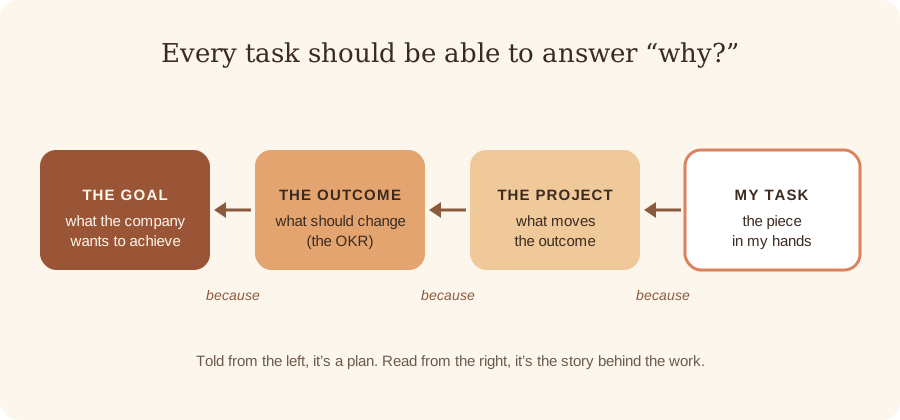
Most of us want to know where our work fits. Not out of curiosity: it’s how we judge whether we’re doing it well.
Goals and OKRs help here, when they’re used as a story and not a scoreboard. Read left to right, the chain explains what the company wants, which outcome a team owns, which project moves it and which task is next. Read back from the right, every task should be able to answer “why?” all the way to something a customer would notice.
That’s also why I prefer outcomes over output. Output is what we shipped: features, tasks, lines of code. Outcomes are what changed because of it: fewer failed exports, a report that arrives on time, an hour saved for someone in finance. Reward output and you get more output. Reward outcomes, and people start choosing the work that actually moves the outcome, including the work nobody asked for, and the work we decide not to do.
What seniority changes#
The story doesn’t only travel down. The more senior you are, the more you’re expected to find it yourself: ask the questions nobody has answered yet, sit with the ambiguity, and come back with a problem clear enough for others to work on.
For a technical lead, that’s most of the job. Scoping includes the story: why this, why now, and what success looks like, written down as criteria the team can check. When someone else sets the criteria for their own piece, they use the same shape, so every part traces back to the same goal.
Who decides the how depends on experience:
- Senior teammates usually should: they have the story and the scope, and they know the system.
- Mid-level teammates mostly can, with a check-in on the approach before they’re deep into it.
- Very junior teammates often can’t yet, however much we’d like that. The approach gets broken down together, with someone close by to ask.
None of this has to be one person’s job. A staff engineer can scope the work and guide a junior teammate personally, or hand both to a senior teammate and stay one level up, supervising the whole. That’s how they scale. What can’t be delegated away is being there: whoever drives a piece of work, small or big, needs someone to make sense of the whole with. On my teams, that’s the tech lead. What matters most is that the roles are clear: who owns the why, the what and the how.
The kind of organisation changes this too. In a flat team, most people hear the same things and the story spreads on its own; the risk is that nobody owns making it clear.
In a hierarchical company, roles decide who hears what, and the story only reaches the work if each level passes it on deliberately. Which brings me to power.
Information is power, and that cuts both ways#
The higher you sit, the more you see: why a priority changed, which customer is about to leave, which budget is under pressure, which team is being reorganised. That’s part of the job, and it’s also a kind of power: whoever knows more decides more.
It’s a double-edged sword. Keep it to yourself, and the teammates doing the work decide blind, and every judgement call has to come back up to the few people who know. Share it all, carelessly, and you hand out half-made plans and worries nobody can act on, which is just anxiety with extra steps.
The skill is sharing what each of us needs to make good decisions in our part of the work: filtered, not censored; early enough to be useful; honest about what’s still uncertain. “We’re not sure yet, here’s what we know and when we’ll know more” beats silence every time.
One line I come back to often is from David Marquet, who turned around a struggling submarine crew by changing who got to decide:
“Don’t move information to authority, move authority to the information.”
— L. David Marquet, Turn the Ship Around!
What I’m trying to do#
These aren’t rules. They’re what I’m practising, with mixed success.
Start with the story. Every kickoff, every OKR, every bigger piece of work: who is it for, what problem does it solve, why now, and what does success look like. Five minutes, written down where the team can find it. If a piece of work can’t say which goal it moves, it’s missing context, or it shouldn’t be done.
Share the trade-offs, not just the decision. “We chose the smaller fix because the big customer’s deadline is in three weeks” lets the next decision be made the same way, without asking.
Say “I don’t know yet.” Silence gets filled with the worst version of the story.
Repeat it, then ask for it back. A story is heard properly the third time, not the first. If a teammate can explain why their work matters in their own words, it landed. If not, I told it badly.
Celebrate the outcome, not the effort. A small change that fixed the real problem deserves more credit than a big one that didn’t.
If you lead a team#
Experienced teammates are usually best placed to decide how; newer ones need more guidance getting there, and giving it is part of the job. Everyone needs the why, and someone to make sense of the whole with. Sharing the story is one of the cheapest things a leader can do, and one of the easiest to forget.
I’m still learning to do it every time. If you have your own ways of making sure the story reaches everyone who needs it, I’d like to hear them.
The book: L. David Marquet, Turn the Ship Around! A True Story of Turning Followers into Leaders (2012).