
The work doesn't speak for itself
Good work doesn't get noticed on its own. Why telling the story of your work matters almost as much as doing it, at every level, in big and small companies.
There’s an idea I hear from engineers all the time: do great work and people will notice. Keep your head down, ship the hard thing, and the recognition will come.
Mostly, it doesn’t. Not because people don’t care, but because they can’t see it. The work happens in your editor, your terminal, your design doc, your head. What other people see is a commit message, a ticket moving to “done”, a line in a weekly update. If that line says “scaled pod X to Y replicas”, nobody outside your team knows you just removed the reason the on-call phone rang every Tuesday night.
Early in my career, as a mid-level engineer who had just joined Networking SRE at Google, I shipped a new API to production and sent a short note to the team about it. My manager at the time read it and told me: “This is great. I want to see more of this.” I’ve never stopped since. It became a habit, and a healthy one, for me and for the team.
To be honest, it always came naturally to me. But I don’t see many people doing it, so it’s become the one thing I tell almost everyone I mentor, whatever their level.
Work that nobody hears about#

Let me be precise, because this can sound cynical. The work happened. The value is real. But the decisions that shape your career are made by people who weren’t there when you did it: your manager’s manager, a promotion committee, whoever picks the team for the next important project. They decide on what reaches them.
In a large company that gap is wide. Promotions are often decided by people who have never worked with you, reading a written case. Your manager argues for you with what’s on the page and what they can remember. If the most interesting thing you did all year lives only in a few code reviews, it isn’t in the room.
Even the people who do know your work need something to work with. A manager who has watched you deliver all year still has to convince a room that hasn’t. That’s far easier when they can point to the updates and write-ups you’ve already sent, in your own words, than when they have to rebuild your impact from memory the week before the committee meets. A strong communication habit doesn’t replace your manager’s support. It’s what makes that support land.
In a smaller company the gap looks narrower: everyone sits close, and the founders know everyone by name. But everyone is also busy, there’s less process to bring things to the surface, and the loudest problem of the week takes all the attention. Quiet work is forgotten just as fast. There’s just no committee to blame.
And it holds at every level. Early on, the person who needs to see your work is your lead. Later it’s the people across the organisation whose plans depend on yours. At the senior end, communication stops being about the job and becomes a big part of it: deciding what’s worth doing, and getting a lot of people to agree.
How much of the job is telling people about it?#

More than feels right. I don’t have a formula, but this is where I’ve landed: communication isn’t something you do after the work, if there’s time left. It’s part of the work, and it deserves real time in your week, not the last ten minutes on a Friday.
What surprised me is that it doesn’t only help other people see the work. It makes the work better:
- Writing down why we’re doing something before starting has killed more of my bad projects than any code review.
- A short update with the risk spelled out gets help weeks earlier than a heroic save at the end.
- Explaining the result to someone outside the team forces me to know what the result actually is. “Scaled pod X to Y replicas” isn’t a result. “On-call no longer gets paged at the evening traffic peak” is.
That’s also why it helps people grow, not just get promoted. People who communicate well get feedback earlier, get pulled into more interesting problems, and learn what the business cares about, because they’re talking to the people who decide. Over a few years that compounds. By the time the promotion comes, it’s often just someone writing down what everyone has already seen.
What I try to do now#
None of this is clever. The hard part is doing it every time, including when the work itself feels more urgent.
Say why before you start. One paragraph: the problem, why now, and what “done” looks like. Share it with the people who’ll care. It takes ten minutes, and it saves the conversation three months later where someone asks why you were doing this at all.
Report outcomes, not activity. “Finished the migration” is activity. “Builds are twice as fast” is an outcome. Lead with what changed for someone, then explain how.
Write for the reader in front of you. The same piece of work needs a sentence for an executive, a paragraph for a director, and a page for the engineers who’ll maintain it. I write the sentence first. If I can’t, I don’t understand the work well enough yet.
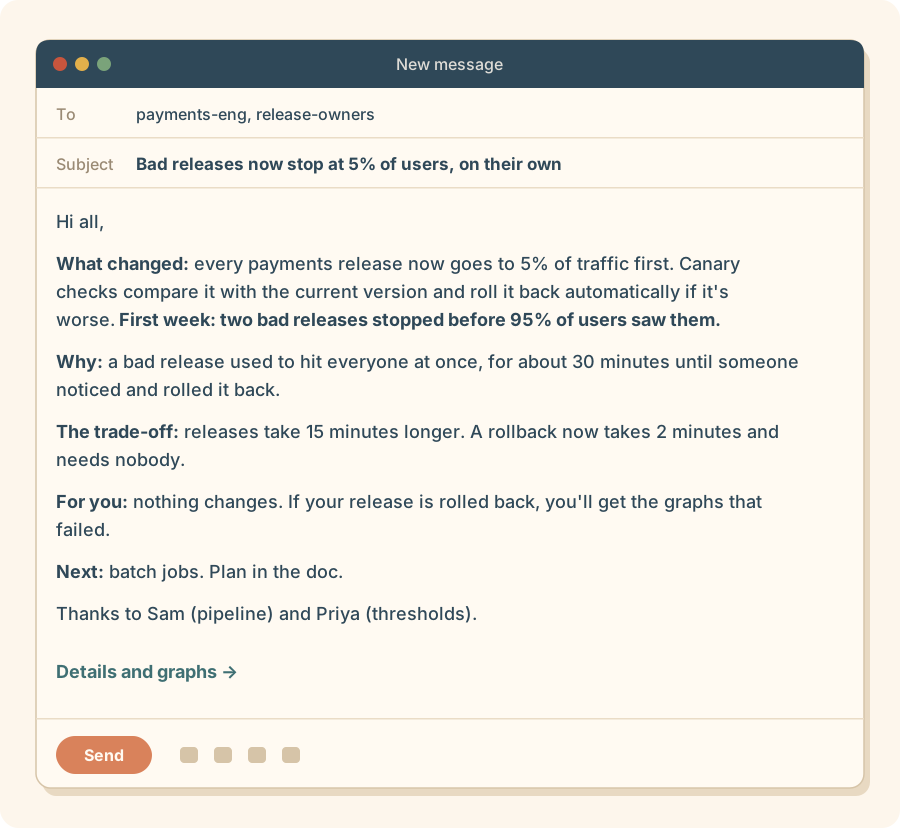
Here’s what that looks like in practice. The version most people send is one line: “Added canary analysis to the payments release pipeline. Done.” Here’s the same news, written for the people reading it:
Make it findable. A short write-up when something lands, with a before and an after, linked from wherever people will look. Six months later, that’s what your manager pastes into your review.
Keep a list. Every week or two, a line for anything that went well, with a link to the evidence. Julia Evans calls it a brag document. The name makes people uncomfortable, which is a good sign that it’s useful. It’s also the same list I mentioned in my last post, for the days the impostor voice is loud.
Name the people who helped. Credit costs nothing and people remember it. A story about “we” travels further than one about “I”, and it’s usually closer to the truth.
Ask what’s missing. Tell your manager what you’re aiming for, then ask plainly: “What would need to be true for that to happen?” Then make sure the answers get communicated, not just done.
Big company, small company#

The habits are the same. What changes is how far your words travel without you.
In a big company, writing is your reach. A good document gets forwarded to people you’ve never met and argues your case in rooms you’ll never be in. Write it well once and it keeps working. The catch is noise: there’s a lot of writing competing for the same attention, so short and clear beats long and complete.
In a smaller company, most of it happens in conversation. The founder or head of engineering hears about your work at lunch, in a stand-up, in a chat thread. That’s faster, but it fades faster too, and it depends on being in the right conversations. The habit that helps most is the same written trail: a short note when something lands, so it still exists after the chat has scrolled away.
It’s not about being loud#
Most engineers I know find this uncomfortable. I’m not one of them: even as a kid I wanted to be at the centre of the stage, so talking about my work never felt like a stretch. But I know that’s not how it feels for most people. To many it feels like self-promotion, like playing a game instead of doing the job. Some of the best engineers I’ve worked with would rather fix three more bugs than write one update.
What I tell them is to stop seeing it as selling themselves and start seeing it as a service. The people around me need to know what changed so they can decide things: what to build next, what’s safe to rely on, where to put people. Telling them clearly is doing them a favour. Leaving them to guess isn’t modesty. It just moves the work onto them.
You don’t need to be loud or charismatic. Quiet, clear and regular works. Some of the people I’d most trust with a promotion case write the shortest updates in the room. They’re just never vague.
If you think your work should speak for itself#
It won’t, and that’s not a judgement on your work. Work doesn’t speak, people do. Give it a voice: the why, the result, and the people who made it happen. And give that voice real time in your week. It’s the cheapest way I know to get better at the job, and the most reliable way I’ve seen for good people to be recognised for being good.
I’m still practising this. If you have a habit that works for you, I’d like to hear it.
The brag document: Julia Evans, “Get your work recognized: write a brag document” (2019).